
Ipamorelin vs Sermorelin vs Tesamorelin: How the Research Compares
Ipamorelin, sermorelin and tesamorelin all increase pituitary growth hormone (GH) release, but by two different routes. Ipamorelin is a five-residue agonist of the ghrelin receptor, while sermorelin (GHRH 1-29) and tesamorelin (a modified GHRH 1-44) are analogs of growth hormone-releasing hormone acting at the GHRH receptor. They also differ sharply in regulatory history and in the depth of their human research.
Two routes to growth hormone release
GH secretion from the pituitary is driven by two stimulatory pathways. The first is growth hormone-releasing hormone (GHRH), a 44-residue amidated peptide whose structure was established in the early 1980s from a human pancreatic tumor that had caused acromegaly1. The second was found in reverse: synthetic GH secretagogues were shown in 1996 to act through a distinct G protein-coupled receptor in the pituitary and hypothalamus, GHS-R2, and in 1999 its natural ligand was identified as ghrelin, an acylated 28-residue peptide from the stomach3.
Because these pathways are separate, a GH-releasing peptide combined with GHRH released GH synergistically in healthy men, more than either alone4. Ipamorelin belongs to the ghrelin-receptor class; sermorelin and tesamorelin belong to the GHRH class. That single fact explains most of the differences below.
Ipamorelin vs sermorelin vs tesamorelin at a glance
The table summarizes how the three peptides differ. Sources for each point are cited in the sections that follow.
| Ipamorelin | Sermorelin | Tesamorelin | |
|---|---|---|---|
| Class | Ghrelin-receptor agonist (synthetic GH secretagogue) | GHRH analog | GHRH analog |
| Origin | Novo Nordisk chemistry program built on the GHRP-1 series, described in 1998 | N-terminal 1-29 fragment of human GHRH, C-terminal amide | Full human GHRH 1-44 with an N-terminal trans-3-hexenoyl group |
| Length | 5 residues (Aib-His-D-2-Nal-D-Phe-Lys-NH2) | 29 residues | 44 residues plus a hexenoyl group |
| Receptor | Ghrelin receptor (GHS-R) | GHRH receptor | GHRH receptor |
| Distinguishing feature | GH release without ACTH or cortisol rise in swine | Shortest GHRH fragment with full activity | Resistant to DPP-IV breakdown; longer plasma persistence |
| Main research models | Rat pituitary cells, rats and swine; postoperative ileus in rats and patients | Pituitary GH-reserve testing and growth in GH-deficient children; aging GH axis | Visceral and liver fat in people with HIV; cognition in older adults |
| Key human finding | Phase 2 ileus trial: no significant difference from placebo | Higher height velocity in GH-deficient children over 12 months | Phase 3: visceral fat -15.2% vs +5.0% with placebo over 26 weeks |
| US regulatory history | Never approved | Approved as Geref (1990 diagnostic, 1997 pediatric GH deficiency); discontinued 2008 | Active ingredient of Egrifta, approved 2010 for excess abdominal fat in HIV-associated lipodystrophy |
Ipamorelin: the selective ghrelin-receptor agonist
Ipamorelin is a pentapeptide, Aib-His-D-2-Nal-D-Phe-Lys-NH2, identified in a Novo Nordisk chemistry program among GHRP-1 analogs lacking its central Ala-Trp dipeptide5. In primary rat pituitary cells it released GH with potency and efficacy similar to GHRP-6, and antagonist studies placed its action at the GHRP receptor rather than the GHRH receptor. Its defining property was selectivity: in swine it did not raise ACTH or cortisol beyond levels seen with GHRH, even far above its GH-releasing range, whereas GHRP-6 and GHRP-2 did5.
Ghrelin-receptor agonists also affect gut motility, which shaped ipamorelin's clinical path. In a rat model of postoperative ileus, repeated intravenous ipamorelin increased fecal pellet output and food intake after abdominal surgery6. A phase 2, randomized, placebo-controlled trial in 117 patients undergoing bowel resection then found it well tolerated but with no significant difference from placebo in time to first tolerated meal or in secondary endpoints7. Ipamorelin has never been approved as a medicine; the ipamorelin page covers the compound in more detail.
Sermorelin: the shortest active GHRH
Sermorelin is GHRH(1-29)-NH2. Early sequencing work showed that the C-terminal part of the 44-residue hormone adds little to its activity: synthetic hpGRF(1-29)-NH2 matched the natural peptide in vitro8. A 1999 review describes sermorelin as the shortest synthetic peptide with the full biological activity of GHRH, specifically stimulating GH secretion from the anterior pituitary9.
Its research history is mainly diagnostic and pediatric. Sermorelin was used as a provocative test of pituitary GH reserve and studied in prepubertal children with idiopathic GH deficiency, where height velocity rose over 12 months but by less than reported with recombinant GH (somatropin)9. Researchers also explored GHRH and GH secretagogues as ways to restore GH secretion in aging, a line of work reviewed by Thorner and colleagues10.
In the US, sermorelin acetate was approved as Geref: a diagnostic presentation in 1990 and a presentation for idiopathic GH deficiency in children with growth failure in 1997. The manufacturer discontinued both in 2008, and in 2013 FDA determined they had not been withdrawn from sale for reasons of safety or effectiveness. See sermorelin for compound details.
Tesamorelin: the stabilized full-length GHRH
Tesamorelin (TH9507) keeps the full 44-residue human GHRH sequence and adds a trans-3-hexenoyl group to Tyr1. Non-clinical studies showed that this makes it resistant to dipeptidyl aminopeptidase-IV, slows its degradation in rat, dog and human plasma and prolongs its plasma elimination compared with native GHRH(1-44)-NH211.
It has the deepest clinical record of the three. In the 2007 phase 3 trial, 412 people with HIV and abdominal fat accumulation were randomized to tesamorelin or placebo for 26 weeks; visceral adipose tissue fell 15.2% versus a 5.0% rise with placebo, and IGF-1 rose 81%12. Later randomized work reported a 37% relative reduction in hepatic fat fraction in people with HIV and fatty liver disease13, and a 20-week controlled trial in 152 older adults with or without mild cognitive impairment reported a favorable effect on executive function14.
Tesamorelin is the active ingredient of Egrifta (now Egrifta SV and Egrifta WR), first approved by FDA in 2010 and labeled for the reduction of excess abdominal fat in HIV-infected adult patients with lipodystrophy. The research peptide is not that medicine; see tesamorelin.
Why researchers compare and combine them
The two classes are compared because they probe different control points. A GHRH analog tests the pituitary's response to its main hypothalamic driver; a ghrelin-receptor agonist tests a parallel pathway that also operates in the hypothalamus2 and the gut6. GH secretagogue research has emphasized restoring pulsatile GH release, which IGF-1 feedback keeps within limits15.
Combining one of each draws on the synergy first shown with GHRH and a GH-releasing peptide in humans4. That rationale underlies research blends such as Tesamorelin + Ipamorelin and CJC-1295 + Ipamorelin. No published study has tested either blend as such; the evidence is for each component and for the general principle.
Limitations of the evidence
- No head-to-head trials compare ipamorelin, sermorelin and tesamorelin; every difference here comes from separate studies in different populations.
- Tesamorelin's human data are concentrated in adults with HIV and central fat accumulation12,13, and its label notes that long-term cardiovascular safety has not been established.
- Sermorelin's clinical literature is older and mostly pediatric9.
- Ipamorelin's selectivity data come from rats and swine5, and its one published efficacy trial was negative7.
- None of these studies used research-grade material. Identity and purity of a research peptide have to be confirmed lot by lot; every Peptides Only lot ships with a lot-matched certificate of analysis in the COA library.
Frequently asked questions
What is the difference between ipamorelin and sermorelin?
Ipamorelin is a five-residue ghrelin-receptor agonist5; sermorelin is the 29-residue active fragment of GHRH, acting at the GHRH receptor9. They reach GH release through different receptors.
How is tesamorelin different from sermorelin?
Both are GHRH analogs. Sermorelin is GHRH(1-29)-NH29; tesamorelin is the full 44-residue sequence with an N-terminal hexenoyl group that resists DPP-IV breakdown and persists longer in plasma11. Tesamorelin also has phase 3 trial data12.
Is ipamorelin a GHRH analog?
No. Antagonist studies showed that ipamorelin, like GHRP-6, acts through the GHRP (ghrelin) receptor rather than the GHRH receptor5.
Why is ipamorelin called selective?
In swine, ipamorelin released GH without significantly raising ACTH or cortisol, unlike GHRP-6 and GHRP-2, and like the other secretagogues tested it did not change FSH, LH, prolactin or TSH5.
Are ipamorelin, sermorelin or tesamorelin FDA-approved?
Only tesamorelin is in an FDA-approved medicine today, Egrifta, for excess abdominal fat in HIV-infected adults with lipodystrophy. Sermorelin was approved as Geref and discontinued in 2008, and ipamorelin has never been approved. Research-grade versions of all three are not approved for human use.
References
- Esch FS, Böhlen P, et al. Primary structures of three human pancreas peptides with growth hormone-releasing activity. J Biol Chem. 1983;258(3):1806-12. PubMed 6130096
- Howard AD, Feighner SD, et al. A receptor in pituitary and hypothalamus that functions in growth hormone release. Science. 1996;273(5277):974-7. PubMed 8688086
- Kojima M, Hosoda H, et al. Ghrelin is a growth-hormone-releasing acylated peptide from stomach. Nature. 1999;402(6762):656-60. PubMed 10604470
- Bowers CY, Reynolds GA, et al. Growth hormone (GH)-releasing peptide stimulates GH release in normal men and acts synergistically with GH-releasing hormone. J Clin Endocrinol Metab. 1990;70(4):975-82. PubMed 2108187
- Raun K, Hansen BS, et al. Ipamorelin, the first selective growth hormone secretagogue. Eur J Endocrinol. 1998;139(5):552-61. PubMed 9849822
- Venkova K, Mann W, et al. Efficacy of ipamorelin, a novel ghrelin mimetic, in a rodent model of postoperative ileus. J Pharmacol Exp Ther. 2009;329(3):1110-6. PubMed 19289567
- Beck DE, Sweeney WB, et al. Prospective, randomized, controlled, proof-of-concept study of the Ghrelin mimetic ipamorelin for the management of postoperative ileus in bowel resection patients. Int J Colorectal Dis. 2014;29(12):1527-34. PubMed 25331030
- Spiess J, Rivier J, et al. Sequence analysis of a growth hormone releasing factor from a human pancreatic islet tumor. Biochemistry. 1982;21(24):6037-40. PubMed 6295453
- Prakash A, Goa KL. Sermorelin: a review of its use in the diagnosis and treatment of children with idiopathic growth hormone deficiency. BioDrugs. 1999;12(2):139-57. PubMed 18031173
- Thorner MO, Chapman IM, et al. Growth hormone-releasing hormone and growth hormone-releasing peptide as therapeutic agents to enhance growth hormone secretion in disease and aging. Recent Prog Horm Res. 1997;52:215-44; discussion 244-6. PubMed 9238854
- Ferdinandi ES, Brazeau P, et al. Non-clinical pharmacology and safety evaluation of TH9507, a human growth hormone-releasing factor analogue. Basic Clin Pharmacol Toxicol. 2007;100(1):49-58. PubMed 17214611
- Falutz J, Allas S, et al. Metabolic effects of a growth hormone-releasing factor in patients with HIV. N Engl J Med. 2007;357(23):2359-70. PubMed 18057338
- Stanley TL, Fourman LT, et al. Effects of tesamorelin on non-alcoholic fatty liver disease in HIV: a randomised, double-blind, multicentre trial. Lancet HIV. 2019;6(12):e821-e830. PubMed 31611038
- Baker LD, Barsness SM, et al. Effects of growth hormone–releasing hormone on cognitive function in adults with mild cognitive impairment and healthy older adults: results of a controlled trial. Arch Neurol. 2012;69(11):1420-9. PubMed 22869065
- Smith RG, Thorner MO. Growth Hormone Secretagogues as Potential Therapeutic Agents to Restore Growth Hormone Secretion in Older Subjects to Those Observed in Young Adults. J Gerontol A Biol Sci Med Sci. 2023;78(Suppl 1):38-43. PubMed 37325967
Compounds discussed
Ipamorelin
Selective ghrelin-receptor agonist for GH-release research.
Sermorelin
GHRH (1-29) analogue for pituitary-axis research.
Tesamorelin
Stabilised GHRH analogue used in visceral-adiposity research.
Tesamorelin + Ipamorelin
GHRH analogue and selective secretagogue in a single vial.
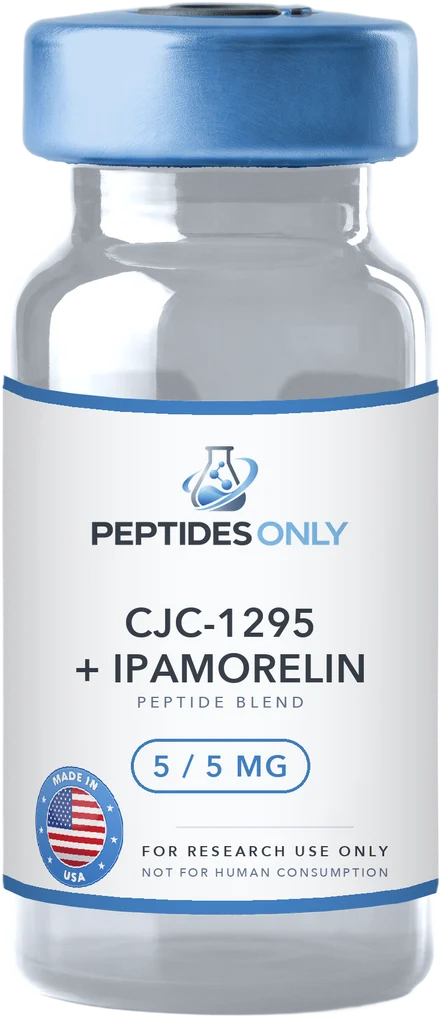
CJC-1295 + Ipamorelin
The classic GH-axis pairing, pre-combined 1:1.
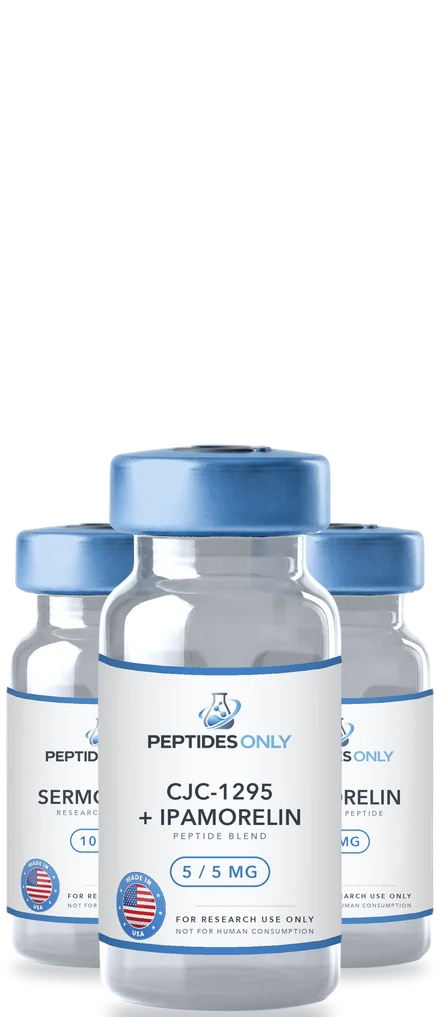
CJC-1295 + Ipamorelin / Sermorelin / Ipamorelin Set
CJC-1295 + Ipamorelin 5 / 5 mg, Sermorelin 10 mg and Ipamorelin 10 mg, supplied together.
- CJC-1295 + Ipamorelin5 / 5 mg
- Sermorelin10 mg
- Ipamorelin10 mg