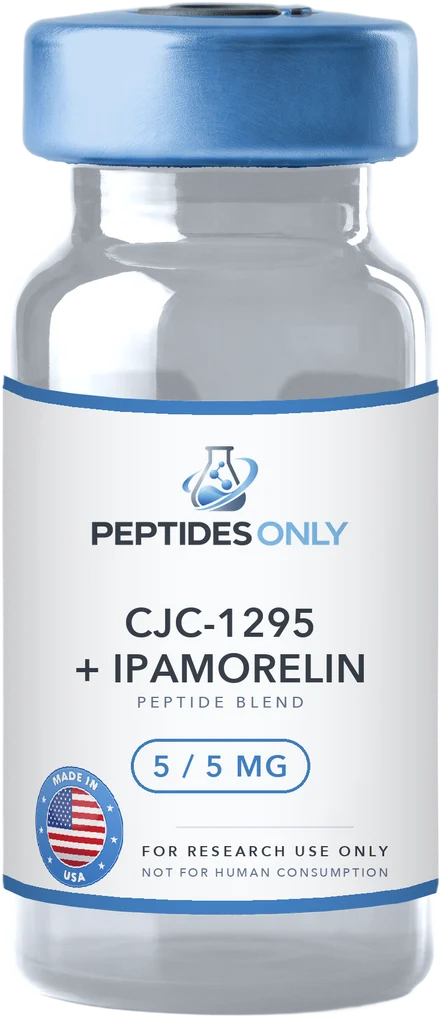
Lyophilized vial
CJC-1295 + Ipamorelin
The classic GH-axis pairing, pre-combined 1:1.
$145.00
2 for $145 · $72.50/vial

GHRH analogue and selective secretagogue in a single vial.
The certificate for the current lot is being uploaded. Every order ships with the COA for its lot, or request it now.
GHRH analogue and selective secretagogue in a single vial.
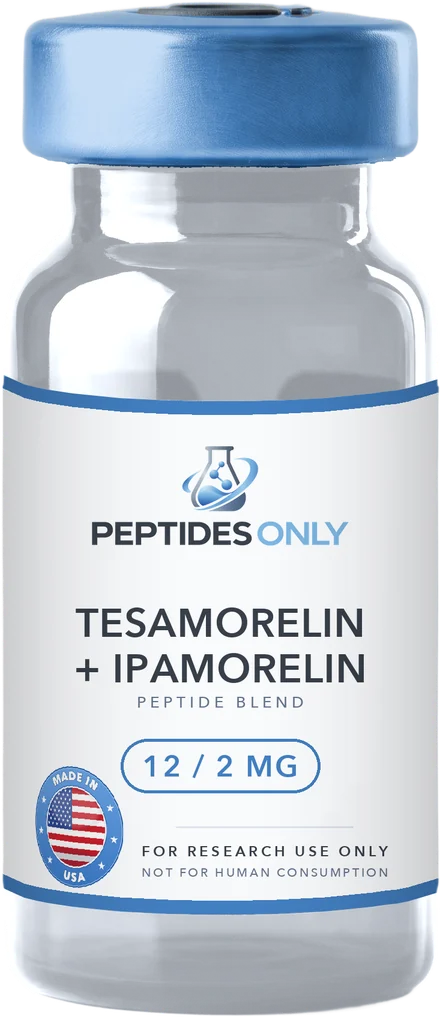
12 / 2 mg per vial, as a lyophilized powder in a sealed glass vial with a crimped cap. The lot number on the label matches the certificate of analysis in the COA library.
Store lyophilized powder frozen (−20 °C) or refrigerated, sealed and away from light. Once reconstituted, keep refrigerated (2–8 °C).
Handle in a laboratory setting using appropriate protective equipment. Consult the certificate of analysis and safety data for lot-specific information.
Tesamorelin + Ipamorelin is a research blend that pairs tesamorelin, a stabilized growth hormone-releasing hormone (GHRH) analog, with ipamorelin, a selective ghrelin-receptor agonist, in one lyophilized vial. The two peptides drive pituitary growth hormone (GH) release through different receptors, which is why GH-axis researchers study the classes together; no published study has tested this exact blend.
Each vial holds 12 mg of tesamorelin and 2 mg of ipamorelin, lyophilized together. Tesamorelin is the 44-residue human GHRH sequence with an N-terminal trans-3-hexenoyl group that resists dipeptidyl aminopeptidase-IV breakdown1. Ipamorelin is the pentapeptide Aib-His-D-2-Nal-D-Phe-Lys-NH22. Both are also sold individually as tesamorelin and ipamorelin.
Because the vial contains two peptides of very different size, identity testing should confirm both. Every Peptides Only lot ships with a lot-matched certificate of analysis (HPLC purity and mass-spec identity) from an independent lab, published in the COA library.
GH secretion has two stimulatory inputs. GHRH acts through its own receptor, while synthetic GH secretagogues act through a separate G protein-coupled receptor in the pituitary and hypothalamus, GHS-R, cloned in 19963; its natural ligand, the stomach peptide ghrelin, was identified in 19994. In healthy men, a GH-releasing peptide given together with GHRH released GH synergistically, and the authors concluded that the two act independently5.
That synergy is the rationale for pairing a GHRH analog with a ghrelin-receptor agonist. Ipamorelin is a logical partner because, in swine, it released GH without significant rises in ACTH or cortisol, a selectivity its developers likened to GHRH itself2.
No published study has examined tesamorelin and ipamorelin together, at this ratio or any other, so the case for combining them rests on earlier work with other GH-releasing peptides and native GHRH5. How the two behave together in a given model, and their stability when stored as a combined lyophilizate, are questions for the researcher. For the wider picture, see Ipamorelin vs Sermorelin vs Tesamorelin.
Not as a blend. Each component has its own literature2,6, and synergy between GHRH and a GH-releasing peptide has been shown with other molecules5, but no published study tests this combination.
Tesamorelin is a 44-residue GHRH analog1; ipamorelin is a five-residue agonist of the ghrelin receptor (GHS-R)2,3. They belong to different classes that converge on pituitary GH release.
Both blends pair a GHRH-receptor agonist with ipamorelin. Here the GHRH component is tesamorelin, the analog with phase 3 clinical data6; the CJC-1295 + Ipamorelin blend uses CJC-1295 instead. Neither blend has been studied as such.
No. Tesamorelin alone is the active ingredient of an FDA-approved medicine; this blend is a research reagent that is not approved for any human use, and ipamorelin has never been approved as a medicine.
Research summary reviewed 2026-10-26 against the cited literature.
The classic GH-axis pairing, pre-combined 1:1.
Four-peptide blend of GHK-Cu, KPV, BPC-157 and TB-500.
BPC-157 and TB-500 combined 1:1 for tissue-repair research.
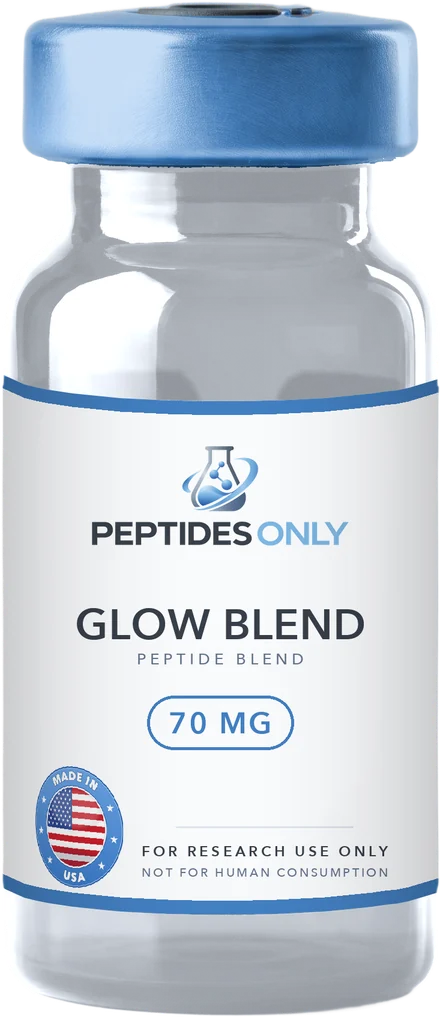
GHK-Cu, BPC-157 and TB-500 blended for skin-matrix research.
Operated by DND Wellness LLC · 1309 Coffeen Ave, Suite 1200, Sheridan, WY 82801.
support@peptides-only.com · (508) 404-8124
Use the chat widget to ask a question. Informational and promotional text messages require separate, optional consent. Message frequency varies. Msg & data rates may apply. Reply STOP to unsubscribe or HELP for help. Consent is not a condition of purchase. 21+.
SMS consent & support · SMS terms & Terms of Service · Privacy Policy