For research use only. Not for human or veterinary use. 21+.
Buy one, get one freeOn every vial · no code neededShop the offer
MANUFACTURED & SHIPPED FROM THE USA
Blends · Skin & Pigment

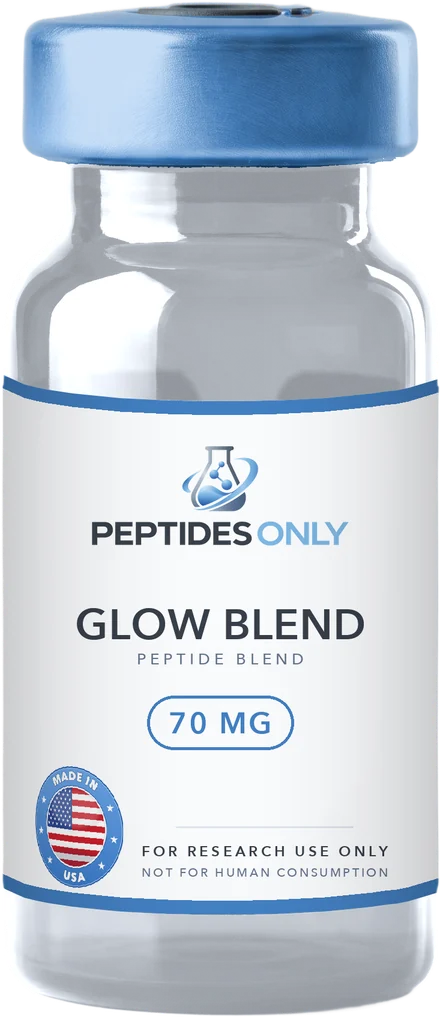
GLOW Blend

99.905% purity · Lot 400001 · tested Feb 20, 2026

GHK-Cu, BPC-157 and TB-500 blended for skin-matrix research.

  • Independently tested
  • Lot-matched COA
  • Lyophilized for stability
  • Ships from the USA
Research use only. Not for human or veterinary use. Sold to qualified researchers aged 21+.
$200.002 for $200 — $100 per vial
Buy one, get one free. Mix and match any 2 eligible vials and the lower-priced one is free — applied automatically. One-time purchases only.
1
GLOW Blend$200.002 for $200
Lot-matched documentation. Every order ships with the certificate for its lot. If a vial arrives damaged or doesn't match its paperwork, tell us within 72 hours and we'll replace it.

Latest lab results

Third-party tested

GLOW Blend 70 mg

Purity (HPLC-UV)
99.905%
Identity (LC-MS)
Confirmed — GHK-Cu / BPC-157 / Thymosin Beta-4
Net content
GHK-Cu 59.50 mg / BPC-157 9.84 mg / TB-500 9.18 mg (label 70 mg)
Lot
400001
Tested
Feb 20, 2026
Lab
Freedom Diagnostics Testing
View certificate (PDF)

Your order ships with the certificate for its own lot.

About GLOW Blend

GHK-Cu, BPC-157 and TB-500 blended for skin-matrix research.

Supplied as

70 mg per vial, as a lyophilized powder in a sealed glass vial with a crimped cap. The lot number on the label matches the certificate of analysis in the COA library.

Storage and handling

Store lyophilized powder frozen (−20 °C) or refrigerated, sealed and away from light. Once reconstituted, keep refrigerated (2–8 °C).

Handle in a laboratory setting using appropriate protective equipment. Consult the certificate of analysis and safety data for lot-specific information.

Important research notice. This product is intended solely for in-vitro and laboratory research. It is not a drug, food, supplement or cosmetic, has not been evaluated by the FDA, and must not be used in humans or animals. Peptides Only does not provide usage or dosing information.

Research summary

GLOW Blend is a research blend of three peptides in one lyophilized vial: the copper peptide GHK-Cu, BPC-157 and TB-500. Each component has its own preclinical literature in skin-matrix and tissue-repair models, but no published study has tested this combination, so the research behind GLOW is the research behind its parts.

Also known as
GLOW peptide blend · GHK-Cu + BPC-157 + TB-500 blend

What is in GLOW Blend?

GLOW Blend contains three peptides. In effect it is the Wolverine Blend pair, BPC-157 and TB-500, plus GHK-Cu; KLOW Blend contains the same three plus a fourth, KPV.

  • GHK-Cu: the copper(II) complex of Gly-His-Lys, a tripeptide isolated from human plasma and studied for collagen and glycosaminoglycan synthesis1,2.
  • BPC-157: a 15-amino-acid partial sequence of a protein found in human gastric juice, studied in rat tendon and skin-wound models3,4.
  • TB-500: the N-acetylated peptide LKKTETQ, a synthetic version of the actin-binding region of thymosin beta-45,6.

Why these peptides are studied together

The rationale is that each component is studied at a different step of tissue repair. GHK-Cu research centers on the extracellular matrix: it stimulated collagen synthesis in fibroblast cultures at nanomolar concentrations1 and increased collagen and glycosaminoglycan accumulation in rat wound chambers2. BPC-157 research centers on cell behavior: it increased the outgrowth, survival under oxidative stress and migration of rat tendon fibroblasts, with activation of the FAK-paxillin pathway3. Thymosin beta-4 research centers on migration and new vessel growth: in full-thickness rat wounds it increased re-epithelialization, collagen deposition and angiogenesis, and it stimulated keratinocyte migration7.

That is a hypothesis about complementary mechanisms, not a tested result. The one controlled study that combined two of these peptides, BPC-157 and TB-500 in a rat Achilles tendon model, found no additional effect from the combination compared with either peptide alone8.

Limitations of the evidence

  • No published study has examined GLOW Blend, or GHK-Cu combined with BPC-157 and TB-500, in any model.
  • Most thymosin data come from the full-length 43-residue protein6. A 2024 study found that in fibroblast assays a TB-500 metabolite, Ac-LKKTE, rather than the parent peptide, showed significant wound-closure activity9.
  • Clinical evidence for GHK-Cu is sparse10, and human evidence for BPC-157 consists of a few small studies rated very low certainty11.

Sourcing GLOW Blend for research

Peptides Only supplies GLOW Blend as a lyophilized powder for laboratory research only. Each lot ships with a lot-matched certificate of analysis (HPLC purity and mass-spec identity) from an independent lab, published in our COA library. For designs that need to separate the effect of each peptide, the components are also sold individually, and GLOW vs KLOW vs Wolverine sets the three blends side by side.

GLOW Blend FAQ

What is the difference between GLOW and KLOW?

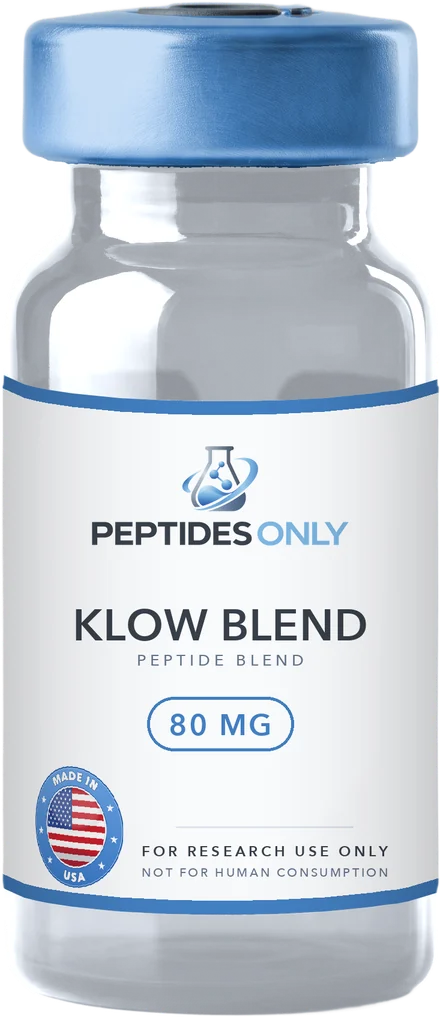
KLOW contains everything in GLOW (GHK-Cu, BPC-157 and TB-500) plus KPV, the C-terminal tripeptide of alpha-MSH, which is studied in inflammation models12. Neither blend has been studied as a mixture.

What is the difference between GLOW and Wolverine Blend?

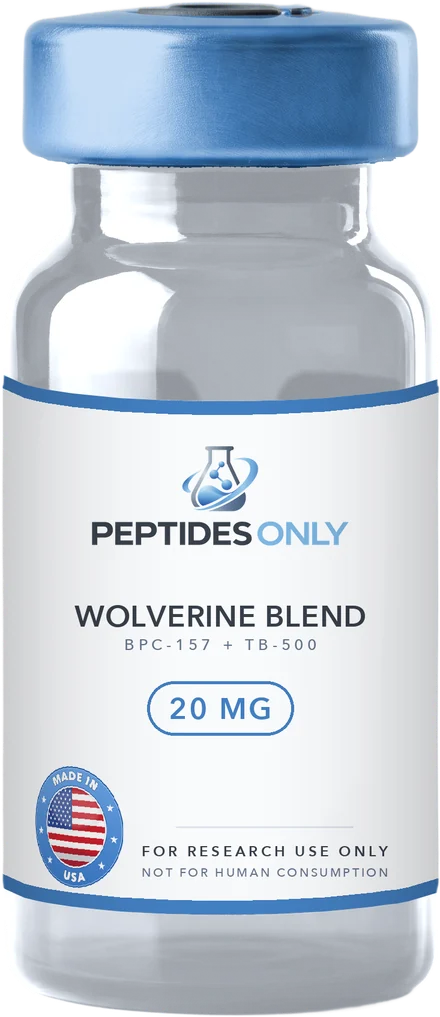
Wolverine Blend contains only BPC-157 and TB-500. GLOW adds GHK-Cu, whose research focuses on collagen synthesis and extracellular-matrix accumulation1,2.

Has GLOW Blend been tested in clinical trials?

No. There are no clinical trials or animal studies of GLOW Blend as a product; the published research concerns its individual components.

Is GLOW Blend approved by the FDA?

No. None of its components is an approved drug: BPC-157 lacks regulatory approval for human use11, GHK-Cu is regarded as an unproven therapeutic agent10, and TB-500 originated as a veterinary preparation that equine doping-control laboratories test for5. GLOW Blend is sold for laboratory research only.

Further reading

References

  1. Maquart FX, Pickart L, et al. Stimulation of collagen synthesis in fibroblast cultures by the tripeptide-copper complex glycyl-L-histidyl-L-lysine-Cu2+. FEBS Lett. 1988;238(2):343-6. PubMed 3169264
  2. Maquart FX, Bellon G, et al. In vivo stimulation of connective tissue accumulation by the tripeptide-copper complex glycyl-L-histidyl-L-lysine-Cu2+ in rat experimental wounds. J Clin Invest. 1993;92(5):2368-76. PubMed 8227353
  3. Chang CH, Tsai WC, et al. The promoting effect of pentadecapeptide BPC 157 on tendon healing involves tendon outgrowth, cell survival, and cell migration. J Appl Physiol (1985). 2011;110(3):774-80. PubMed 21030672
  4. Seiwerth S, Milavic M, et al. Stable Gastric Pentadecapeptide BPC 157 and Wound Healing. Front Pharmacol. 2021;12:627533. PubMed 34267654
  5. Ho EN, Kwok WH, et al. Doping control analysis of TB-500, a synthetic version of an active region of thymosin β₄, in equine urine and plasma by liquid chromatography-mass spectrometry. J Chromatogr A. 2012;1265:57-69. PubMed 23084823
  6. Sosne G, Qiu P, et al. Biological activities of thymosin beta4 defined by active sites in short peptide sequences. FASEB J. 2010;24(7):2144-51. PubMed 20179146
  7. Malinda KM, Sidhu GS, et al. Thymosin beta4 accelerates wound healing. J Invest Dermatol. 1999;113(3):364-8. PubMed 10469335
  8. Biçer O, Adanir O, et al. Effects of BPC-157 and TB-500 on Achilles tendon healing in rats: A histopathological and biomechanical study. Jt Dis Relat Surg. 2026;37(3):822-837. PubMed 42542926
  9. Rahaman KA, Muresan AR, et al. Simultaneous quantification of TB-500 and its metabolites in in-vitro experiments and rats by UHPLC-Q-Exactive orbitrap MS/MS and their screening by wound healing activities in-vitro. J Chromatogr B Analyt Technol Biomed Life Sci. 2024;1235:124033. PubMed 38382158
  10. Mateescu DM, Gavrilescu DM, et al. GHK-Cu as a Bioactive Metallopeptide and Drug-Delivery Cargo: Coordination Chemistry, Formulation Science, Therapeutic Evidence, and a Translational Roadmap. Pharmaceutics. 2026;18(9):1077. PubMed 42797253
  11. Poolton JT, Minett J, et al. Human evidence for BPC-157 in orthopaedic and regenerative medicine: a systematic review of efficacy and safety. Acta Orthop Belg. 2026;92(3). PubMed 42885452
  12. Kannengiesser K, Maaser C, et al. Melanocortin-derived tripeptide KPV has anti-inflammatory potential in murine models of inflammatory bowel disease. Inflamm Bowel Dis. 2008;14(3):324-31. PubMed 18092346

Research summary reviewed 2026-10-26 against the cited literature.

More Blends

You might also need

View all

Contact Peptides Only

Operated by DND Wellness LLC · 1309 Coffeen Ave, Suite 1200, Sheridan, WY 82801.

support@peptides-only.com · (508) 404-8124

Use the chat widget to ask a question. Informational and promotional text messages require separate, optional consent. Message frequency varies. Msg & data rates may apply. Reply STOP to unsubscribe or HELP for help. Consent is not a condition of purchase. 21+.

SMS consent & support · SMS terms & Terms of Service · Privacy Policy