 99.665%View COA
Lyophilized vial
BPC-157
Stable gastric pentadecapeptide, a staple of tissue-repair research.
$46.99
2 for $46.99 · $23.50/vial w/ BOGO

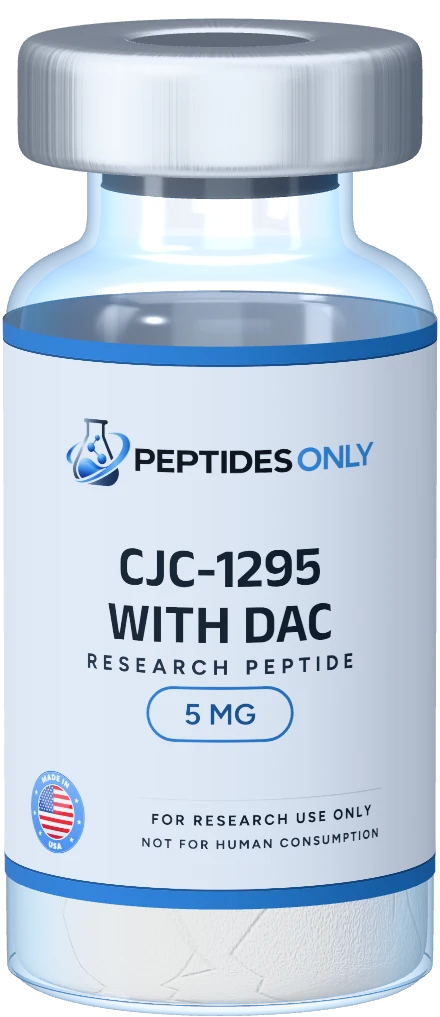
GHRH analogue with a drug affinity complex, for extended half-life GH-axis research.
RFID on the vial. Hold it to the back of your phone and its certificate of analysis opens automatically.
Each tier is 10, 20 or 50 of this exact product and size, no mix and match. Buy One, Get One Free and discount codes don't apply.
CJC-1295 (With DAC) 5 mg
Your order ships with the certificate for its own lot. 1 earlier certificate for this size in the COA library.
GHRH analogue with a drug affinity complex, for extended half-life GH-axis research.
5 mg per vial, as a lyophilized powder in a sealed glass vial with a crimped cap. The lot number on the label matches the certificate of analysis in the COA library, and the RFID tag on the vial opens that certificate when you hold it to the back of your phone.
Store lyophilized powder frozen (−20 °C) or refrigerated, sealed and away from light. Once reconstituted, keep refrigerated (2–8 °C).
Handle in a laboratory setting using appropriate protective equipment. Consult the certificate of analysis and safety data for lot-specific information.
CJC-1295 with DAC is a long-acting synthetic analogue of growth hormone-releasing hormone (GHRH): the tetrasubstituted GHRH(1-29) peptide plus an extra lysine carrying a maleimidopropionyl group, the drug affinity complex, which bonds covalently to serum albumin1. It is the compound used in the published human studies of CJC-1295, which reported an estimated half-life of 5.8 to 8.1 days and sustained rises in growth hormone (GH) and IGF-I in healthy adults2. It is not an approved medicine and is sold for laboratory research only.
CJC-1295 was developed at ConjuChem, whose researchers built three maleimido derivatives of human GRF(1-29) designed to attach to albumin. All three albumin conjugates resisted dipeptidyl peptidase IV (DPP-IV) in vitro and released GH from cultured rat pituitary cells. The lead compound, CJC-1295, produced a fourfold larger GH area under the curve than GRF(1-29) over two hours in rats and was detectable in plasma beyond 72 hours1.
Its peptide portion is the tetrasubstituted 29-residue sequence (D-alanine 2, glutamine 8, alanine 15, leucine 27) that is also sold on its own as CJC-1295 without DAC. The drug affinity complex is the additional C-terminal lysine and its maleimide group1. The CJC-1295 + Ipamorelin blend uses the version without DAC.
Native GHRH lasts minutes in circulation: intact GHRH(1-44) had a half-life of about 6.8 minutes after intravenous administration in people, largely because DPP-IV cleaves it at the N terminus3. The same limitation applies to sermorelin. The DAC approach sidesteps it by tying the peptide to albumin. The maleimide group reacts with the free thiol on cysteine 34 of serum albumin; in rats, a CJC-1295-immunoreactive band appeared at the albumin position within 15 minutes and was still present beyond 24 hours1.
Later papers describe the compound as binding selectively and covalently, in effect permanently, to endogenous albumin after administration4,5.
Two randomized, placebo-controlled, double-blind trials in healthy adults aged 21 to 61, lasting 28 and 49 days, tested single and repeated administration at ascending amounts. After a single administration, mean plasma GH rose 2- to 10-fold for six days or more and mean IGF-I rose 1.5- to 3-fold for 9 to 11 days, with larger amounts producing larger increases. The estimated half-life was 5.8 to 8.1 days; with repeated administration, IGF-I stayed above baseline for up to 28 days, and no serious adverse reactions were reported2.
A follow-up study sampled blood every 20 minutes overnight in healthy men aged 20 to 40, before and one week after a single administration. GH pulses persisted with unchanged frequency and size, but trough GH rose about 7.5-fold, mean GH by 46% and IGF-I by 45%; the IGF-I rise did not correlate with any measure of pulsatile secretion5. A proteomic analysis of serum from 11 healthy young men, before and one week after administration, found shifts in apolipoprotein A1, transthyretin and albumin-fragment spots that the authors proposed as candidate biomarkers of GH and IGF-I action6.
In mice lacking the GHRH gene, CJC-1295 given daily for five weeks from one week of age produced normal body weight and length, while the same amount given every 48 or 72 hours improved growth without fully normalizing it. Treated animals showed more pituitary GH mRNA and evidence of somatotroph proliferation4. Even for a long-acting analogue, the interval between administrations mattered in this model.
CJC-1295 reached clinical trials in healthy adults2 but has not been approved as a medicine. It is classed as a prohibited substance under section S2 of the World Anti-Doping Agency list7, and doping-control laboratories have developed methods that detect both CJC-1295 and CJC-1295 with DAC8.
Both share the same tetrasubstituted GHRH(1-29) backbone; only the DAC version carries the albumin-binding lysine, which gives it a half-life measured in days in people2. We compare them in detail in CJC-1295 with DAC vs without DAC.
In healthy adults the estimated half-life was 5.8 to 8.1 days2; a later paper summarized it as about eight days5.
In the one study that measured it, no. Pulse frequency and size were unchanged one week after a single administration, while trough and mean GH rose5.
No. It was studied in early clinical trials2 but has never been approved, and it is prohibited in sport7. Peptides Only supplies it for laboratory research only.
Yes. DAC:GRF is shorthand for a GRF(1-29) analogue carrying the drug affinity complex, which is CJC-1295 as originally described1. The version without the complex is sold as CJC-1295 without DAC or Mod GRF (1-29).
Research summary reviewed 2026-10-26 against the cited literature.
99.665%View COAStable gastric pentadecapeptide, a staple of tissue-repair research.
 99.75%View COA
Copper-binding tripeptide used in collagen and skin-matrix research.
 99.85%View COA
Essential coenzyme for studies of cellular metabolism and ageing.
 99.859%View COA
Thymosin beta-4 fragment studied for cell migration and repair.
Operated by DND Wellness LLC · 1309 Coffeen Ave, Suite 1200, Sheridan, WY 82801.
support@peptides-only.com · (508) 404-8124
Use the chat widget to ask a question. Informational and promotional text messages require separate, optional consent. Message frequency varies. Msg & data rates may apply. Reply STOP to unsubscribe or HELP for help. Consent is not a condition of purchase. 21+.
SMS consent & support · SMS terms & Terms of Service · Privacy Policy