Lyophilized vial
BPC-157
Stable gastric pentadecapeptide, a staple of tissue-repair research.
$85.00
2 for $85 · $42.50/vial

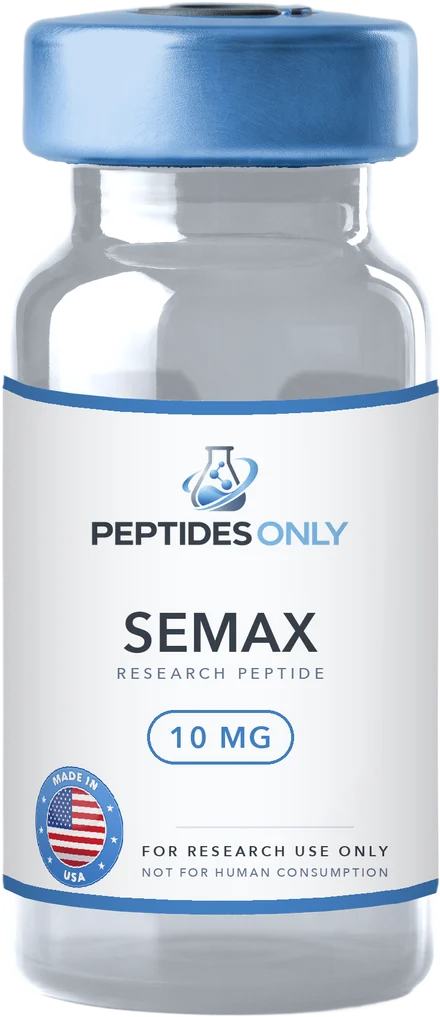
ACTH (4-10) analogue studied in BDNF-expression research.
Semax 10 mg
Your order ships with the certificate for its own lot.
ACTH (4-10) analogue studied in BDNF-expression research.
10 mg per vial, as a lyophilized powder in a sealed glass vial with a crimped cap. The lot number on the label matches the certificate of analysis in the COA library.
Store lyophilized powder frozen (−20 °C) or refrigerated, sealed and away from light. Once reconstituted, keep refrigerated (2–8 °C).
Handle in a laboratory setting using appropriate protective equipment. Consult the certificate of analysis and safety data for lot-specific information.
Semax is a synthetic seven-amino-acid peptide (Met-Glu-His-Phe-Pro-Gly-Pro) that joins the ACTH(4-7) fragment of adrenocorticotropic hormone to a stabilizing Pro-Gly-Pro tail. It is studied mainly for its effects on brain-derived neurotrophic factor (BDNF) and on gene expression in rodent models of cerebral ischemia, in a literature that comes largely from Russian research groups. Peptides Only supplies Semax as a lyophilized compound for laboratory research only.
Semax is a synthetic analog of ACTH(4-10), a fragment of adrenocorticotropic hormone. Its sequence, Met-Glu-His-Phe-Pro-Gly-Pro, keeps the ACTH(4-7) segment and ends in the tripeptide Pro-Gly-Pro, which is why Russian papers often call it ACTH(4-7)PGP1,2.
The Pro-Gly-Pro ending is deliberate. Pro-Gly-Pro belongs to the glyprolines, a peptide family that Moscow physiologists described as far more resistant to breakdown than most regulatory peptides, and Semax and its sister peptide Selank were designed as hybrids that pair an active fragment with this glyproline tail3. Semax is still metabolized: in experiments with tritium-labeled peptide and nerve cells, its main breakdown products were the pentapeptide His-Phe-Pro-Gly-Pro and the tripeptide Pro-Gly-Pro4.
The best-known Semax findings concern brain-derived neurotrophic factor (BDNF), a growth factor involved in synaptic plasticity, and its receptor TrkB. In glial cells cultured from the basal forebrain of newborn rats, Semax raised BDNF mRNA about eightfold and NGF mRNA about fivefold, with the largest change at 30 minutes5.
In adult rats given Semax intranasally, BDNF protein rose within three hours in the basal forebrain but not in the cerebellum, and membranes from the basal forebrain showed specific, calcium-dependent binding sites for labeled Semax6. A follow-up study in the rat hippocampus reported increases in BDNF protein, TrkB phosphorylation, and BDNF and TrkB mRNA, together with more conditioned avoidance responses in a learning task1.
These are short-term expression measurements, mostly in healthy rodents. They show that Semax changes neurotrophin signaling in specific brain regions, but the binding site described in rat forebrain has not been tied to a named receptor in these studies6.
A second body of work uses rat models of stroke-like injury, chiefly occlusion of the middle cerebral artery. After permanent occlusion, Semax increased transcription of Bdnf, Ngf, Nt-3 and Trk receptor genes in the ischemic cortex at time points from 3 to 72 hours; the Pro-Gly-Pro fragment alone also changed these genes, but in a largely non-specific way2. A genome-wide analysis of the same model found that more than half of the genes Semax altered at 24 hours were immune-related, with further changes in genes linked to blood-vessel formation7.
With transient occlusion followed by reperfusion, RNA sequencing identified 394 genes expressed differently in Semax-treated rats than in saline controls at 24 hours. Semax suppressed inflammation-related genes and activated neurotransmission-related genes, roughly the reverse of the pattern produced by ischemia-reperfusion alone8. These studies measure gene expression at fixed time points; they are not long-term recovery studies.
In human serum tested in vitro, Semax and Selank both inhibited enkephalin-degrading enzymes more strongly than reference peptidase inhibitors such as puromycin and bacitracin. Because these enzymes also break down other regulatory peptides, the authors proposed this as one route by which the two heptapeptides could act9.
Human data are limited. A resting-state fMRI study in 24 healthy volunteers compared intranasal Semax with placebo and reported a larger rostral subcomponent of the brain's default mode network in the Semax group10. In a Russian study of 110 patients in rehabilitation after ischemic stroke, plasma BDNF levels were higher in the subgroups that received Semax; the abstract does not describe randomization or blinding11.
Most Semax research comes from a small network of Moscow institutions, especially the Institute of Molecular Genetics of the Russian Academy of Sciences, and much of it appears in Russian-language or Russian-edited journals1,7. Western regulators have not evaluated it: Belgian control-laboratory scientists who identified Semax and Selank in seized preparations described them as research peptides sold online that, to their knowledge, had not completed clinical trials12.
Every Peptides Only lot of Semax is independently tested and ships from the USA with a lot-matched certificate of analysis showing HPLC purity and mass-spec identity, published in our certificate library. Semax is also available with Selank and Pinealon in the Semax / Selank / Pinealon Set.
No. Semax is not an FDA-approved drug and has not been authorized by the European Medicines Agency. Russian authors describe it as a medicine used in Russia for patients with disorders of cerebral circulation8. Peptides Only sells it strictly as a research compound for laboratory use.
Both are Russian-developed heptapeptides that end in Pro-Gly-Pro, but they start from different parent sequences: Semax from the ACTH(4-7) fragment, Selank from the tuftsin sequence Thr-Lys-Pro-Arg9,3. Semax research centers on BDNF and ischemia models; Selank research centers on GABAergic signaling and stress behavior in rodents. See Semax vs Selank for a side-by-side comparison.
No. ACTH(4-10) is a natural fragment of adrenocorticotropic hormone (Met-Glu-His-Phe-Arg-Trp-Gly). Semax keeps the first four of those residues and replaces the last three with Pro-Gly-Pro, so the literature describes it as an ACTH(4-10) analog rather than the fragment itself1,2.
Semax was developed by Russian researchers, and nearly all mechanistic studies come from Moscow institutes such as the Institute of Molecular Genetics5,2. That concentration is a reason for caution: independent replication outside Russia is sparse.
Like most lyophilized peptides, sealed vials are generally kept cold, dry and protected from light. Our guide to peptide storage and stability covers the general principles.
Research summary reviewed 2026-10-26 against the cited literature.
Stable gastric pentadecapeptide, a staple of tissue-repair research.
Copper-binding tripeptide used in collagen and skin-matrix research.
Essential coenzyme for studies of cellular metabolism and ageing.
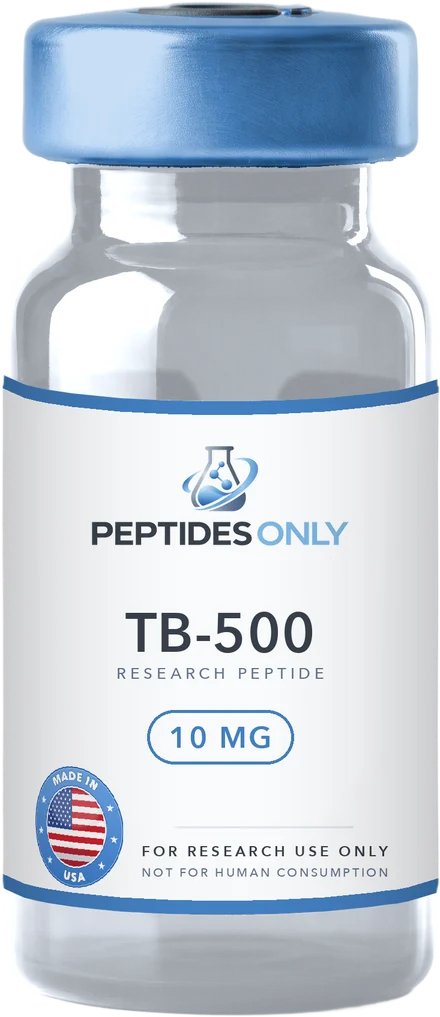
Thymosin beta-4 fragment studied for cell migration and repair.
Operated by DND Wellness LLC · 1309 Coffeen Ave, Suite 1200, Sheridan, WY 82801.
support@peptides-only.com · (508) 404-8124
Use the chat widget to ask a question. Informational and promotional text messages require separate, optional consent. Message frequency varies. Msg & data rates may apply. Reply STOP to unsubscribe or HELP for help. Consent is not a condition of purchase. 21+.
SMS consent & support · SMS terms & Terms of Service · Privacy Policy