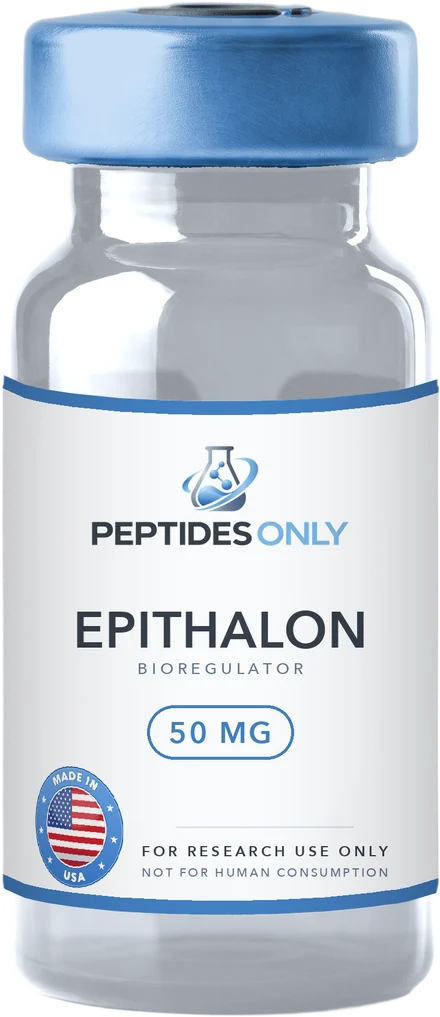
Lyophilized vial
Epithalon
Tetrapeptide studied in telomerase and pineal research.
$185.00
2 for $185 · $92.50/vial

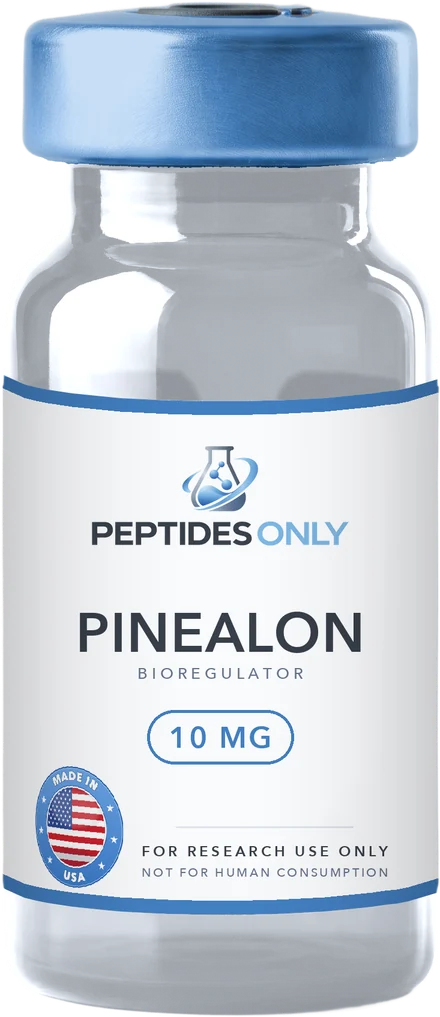
Tripeptide bioregulator explored in neuroprotection research.
The certificate for the current lot is being uploaded. Every order ships with the COA for its lot, or request it now.
Tripeptide bioregulator explored in neuroprotection research.
10 mg per vial, as a lyophilized powder in a sealed glass vial with a crimped cap. The lot number on the label matches the certificate of analysis in the COA library.
Store lyophilized powder frozen (−20 °C) or refrigerated, sealed and away from light. Once reconstituted, keep refrigerated (2–8 °C).
Handle in a laboratory setting using appropriate protective equipment. Consult the certificate of analysis and safety data for lot-specific information.
Pinealon is a synthetic tripeptide, Glu-Asp-Arg (EDR), from the short-peptide bioregulator program led by Vladimir Khavinson at the St. Petersburg Institute of Bioregulation and Gerontology. It has been studied in cell cultures and rodent models of oxidative stress, hypoxia and amyloid toxicity, where researchers measured cell survival, dendritic spines and gene expression. Peptides Only supplies Pinealon as a lyophilized compound for laboratory research only.
Pinealon is the synthetic tripeptide Glu-Asp-Arg, usually abbreviated EDR in the literature1. It belongs to a family of short peptides that Khavinson's group calls bioregulators. That program began with polypeptide extracts of animal organs, such as the pineal preparation epithalamin and the thymic preparation thymalin, and moved on to synthetic di- and tetrapeptides designed from the amino-acid composition of those extracts, each reported to act on a matching tissue2. Its better-known relative is the tetrapeptide Epithalon.
Despite the name, most Pinealon studies look at nerve cells rather than the pineal gland: cerebellar granule neurons, cortical cell cultures, hippocampal neurons and neurons induced from human skin fibroblasts1,3,4,5.
In the first detailed cell study, Pinealon limited the accumulation of reactive oxygen species in rat cerebellar granule cells, neutrophils and PC12 cells exposed to oxidative stress, reduced necrotic cell death, delayed ERK1/2 activation and altered the cell cycle, all in a concentration-dependent way. Because the cell-cycle effects continued at concentrations above those where the antioxidant effects leveled off, the authors proposed that the peptide also acts on the genome1.
In rats fed excess methionine during pregnancy to raise homocysteine, offspring of dams given Pinealon performed better in spatial orientation and learning tests, and their cerebellar neurons accumulated fewer reactive oxygen species6. In old rats exposed to acute hypoxia, researchers measured brain caspase-3 activity and serum interleukin-6 and TNF, and interpreted the Pinealon results as a return of neuroinflammatory markers toward reference levels7.
Several studies use models of amyloid synaptotoxicity. In cultured mouse hippocampal neurons exposed to amyloid, EDR restored the number of mushroom-type dendritic spines to normal levels4. In 5xFAD transgenic mice, EDR and a related tripeptide prevented dendritic spine loss8. In neurons induced from elderly donors' fibroblasts, EDR increased dendritic branching and reduced oxidative DNA damage, but did not change mitochondrial or lysosomal activity or levels of the senescence marker p165.
Khavinson's group proposes that EDR enters cells and binds histone proteins or nucleic acids, changing the activity of the MAPK/ERK pathway and the synthesis of proteins such as caspase-3, p53, SOD2, GPX1 and the PPAR transcription factors9. Much of the supporting evidence is computational: docking studies placed EDR at promoter sequences of genes including CASP3, APOE, SOD2 and PPARG8, and modeling ranked EDR among ultrashort peptides that could be carried into cells by the LAT1, LAT2 and PEPT1 transporters10. In aging cortical cell cultures, EDR was reported to increase serotonin expression, with docking used to propose a link to the tryptophan hydroxylase gene3. These are hypotheses that independent laboratories have not yet tested.
The Pinealon literature is small and comes almost entirely from Khavinson's institute and its St. Petersburg collaborators, often in Russian-language journals such as Advances in Gerontology. We found no independent replication in PubMed-indexed research.
Human data are limited to small Russian studies. In one, 32 people aged 41 to 83 with organic brain syndrome were assessed on biological-age indicators after Pinealon and a related peptide; the same report noted prooxidant activity and a fall in circulating CD34-positive cells, and the abstract does not describe randomization or blinding11.
Pinealon sits in our bioregulators range and is also part of the Semax / Selank / Pinealon Set. Every lot is independently tested and ships from the USA with a lot-matched certificate of analysis showing HPLC purity and mass-spec identity, published in our certificate library.
No. Pinealon is a tripeptide (Glu-Asp-Arg); Epitalon, also spelled Epithalon, is a tetrapeptide (Ala-Glu-Asp-Gly). Both come from the same Russian bioregulator program, but Epitalon research has focused on the pineal gland, melatonin and aging markers, while Pinealon research has focused on nerve cells2,1. See Epitalon vs Pinealon.
No. Pinealon is not an FDA-approved drug and has not been authorized by the European Medicines Agency. Peptides Only sells it strictly as a research compound for laboratory use.
It is the term Khavinson's group uses for short peptides designed from organ extracts and proposed to regulate gene expression in specific tissues2,9. It describes a research hypothesis from one school of gerontology rather than an established drug class.
Pinealon is made synthetically. Despite its name, published work on it centers on neurons rather than on pineal function1,4.
Like most lyophilized peptides, sealed vials are generally kept cold, dry and protected from light. See our guide to peptide storage and stability.
Research summary reviewed 2026-10-26 against the cited literature.
Operated by DND Wellness LLC · 1309 Coffeen Ave, Suite 1200, Sheridan, WY 82801.
support@peptides-only.com · (508) 404-8124
Use the chat widget to ask a question. Informational and promotional text messages require separate, optional consent. Message frequency varies. Msg & data rates may apply. Reply STOP to unsubscribe or HELP for help. Consent is not a condition of purchase. 21+.
SMS consent & support · SMS terms & Terms of Service · Privacy Policy