 99.665%View COA
Lyophilized vial
BPC-157
Stable gastric pentadecapeptide, a staple of tissue-repair research.
$46.99
2 for $46.99 · $23.50/vial w/ BOGO

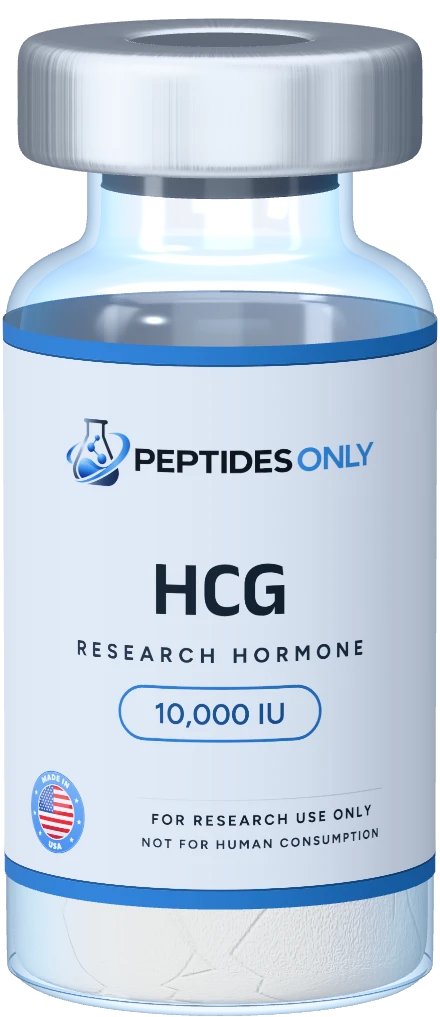
Glycoprotein hormone used in LH-receptor and reproductive endocrinology research.
RFID on the vial. Hold it to the back of your phone and its certificate of analysis opens automatically.
Each tier is 10, 20 or 50 of this exact product and size, no mix and match. Buy One, Get One Free and discount codes don't apply.
The certificate for the current lot is being uploaded. Every order ships with the COA for its lot, or request it now.
Glycoprotein hormone used in LH-receptor and reproductive endocrinology research.
10,000 IU per vial, as a lyophilized powder in a sealed glass vial with a crimped cap. The lot number on the label matches the certificate of analysis in the COA library, and the RFID tag on the vial opens that certificate when you hold it to the back of your phone.
Store lyophilized powder frozen (−20 °C) or refrigerated, sealed and away from light. Once reconstituted, keep refrigerated (2–8 °C).
Handle in a laboratory setting using appropriate protective equipment. Consult the certificate of analysis and safety data for lot-specific information.
Human chorionic gonadotropin (hCG) is a glycoprotein hormone made mainly by the placenta, built from an alpha subunit shared with LH, FSH and TSH and a hormone-specific beta subunit. It acts at the same receptor as luteinizing hormone, the LH/CG receptor, which makes it a standard tool in reproductive endocrinology and LH-receptor research. The material sold here is a research reagent, separate from FDA-approved prescription hCG medicines.
hCG is the first hormonal message from the placenta to the mother: it is detectable in maternal blood shortly after implantation and behaves like an agonist of LH, stimulating progesterone secretion by the corpus luteum1. It is a heterodimer. The alpha subunit is identical to that of the pituitary hormones LH, FSH and TSH, while the beta subunit is distinct and confers receptor specificity; hCG-beta carries two N-linked and four O-linked glycosylation sites1.
The crystal structure, solved in 1994, showed that each subunit folds around a cystine knot and that a segment of the beta subunit wraps around the alpha subunit like a seat belt, a feature needed for both heterodimer assembly and receptor binding2. hCG-beta also has a carboxyl-terminal peptide extension that the other beta subunits lack; its O-linked sugars play little part in receptor binding but are critical for in vivo half-life3.
hCG and LH share one receptor, LHCGR, cloned from rat ovary in 1989: a G protein-coupled receptor with a large leucine-rich extracellular domain that raises cAMP when bound by hCG4. Because the two hormones share that receptor, they were long treated as equivalent, but they differ in structure, half-life and signaling5.
In cells engineered to express LHCGR, hCG was about five-fold more potent than LH at raising cAMP, whereas LH activated ERK1/2 and AKT more strongly in human granulosa cells6. Real-time BRET and FRET studies describe the two as natural biased agonists of the same receptor7. In mouse Leydig cells, by contrast, hCG and LH differed in early signaling but produced equal testosterone synthesis8, so results depend on the cell model.
FDA-approved hCG products exist, including urine-derived chorionic gonadotropin and a recombinant form, choriogonadotropin alfa; they are prescription-only and approved for specific reproductive-endocrine indications. FDA states that there are no FDA-approved hCG products for weight loss, and the prescription labeling says hCG has not been demonstrated to be effective adjunctive therapy for obesity. A 1995 criteria-based meta-analysis of 24 trials reached the same conclusion, finding no scientific evidence that hCG produces weight loss or fat redistribution10.
Research-grade hCG, including the product sold here, is not any of those medicines. It is supplied for in vitro and animal research only, and Peptides Only provides no information on human use.
hCG is a family of glycoforms rather than a single molecule, and biological activity varies with source and glycosylation1,9; LH and hCG are also not interchangeable at the receptor level5. Researchers should record the source of any hCG they use and confirm identity by lot. Every Peptides Only lot ships with a lot-matched certificate of analysis from an independent lab, published in the COA library; see our testing standard and how to read a peptide COA.
Yes, as prescription medicines approved for specific reproductive-endocrine indications. Those approvals do not cover research-grade material, and FDA states that there are no FDA-approved hCG products for weight loss.
No. They share the alpha subunit and the LH/CG receptor, but their beta subunits differ, LH has a half-life of about 90 minutes while hCG's is measured in hours, and the two trigger different signaling patterns in human granulosa cells5,6.
A 1995 meta-analysis of controlled and uncontrolled trials found no scientific evidence that hCG causes weight loss or fat redistribution, or reduces hunger10, and FDA states that no hCG products are approved for weight loss. Peptides Only does not sell hCG for that or any other human use.
The hCG beta subunit carries a carboxyl-terminal peptide with O-linked oligosaccharides that is critical for its in vivo half-life3.
It is a heterodimeric glycoprotein hormone: two glycosylated protein subunits held together noncovalently3 and stabilized by a seat-belt segment of the beta subunit2. That makes it far larger and more complex than short synthetic research peptides. General handling guidance is in peptide storage and stability.
Research summary reviewed 2026-10-26 against the cited literature.
99.665%View COAStable gastric pentadecapeptide, a staple of tissue-repair research.
 99.75%View COA
Copper-binding tripeptide used in collagen and skin-matrix research.
 99.85%View COA
Essential coenzyme for studies of cellular metabolism and ageing.
 99.859%View COA
Thymosin beta-4 fragment studied for cell migration and repair.
Operated by DND Wellness LLC · 1309 Coffeen Ave, Suite 1200, Sheridan, WY 82801.
support@peptides-only.com · (508) 404-8124
Use the chat widget to ask a question. Informational and promotional text messages require separate, optional consent. Message frequency varies. Msg & data rates may apply. Reply STOP to unsubscribe or HELP for help. Consent is not a condition of purchase. 21+.
SMS consent & support · SMS terms & Terms of Service · Privacy Policy